Primary research interests lie in the combined effects of tropospheric ozone and environmental stress factors on plants (semi-natural and crops) and forest Mediterranean ecosystems. I investigated plant physiological processes, and symptom expression of ozone visible injury and I used these data to assess the risk of tropospheric ozone on forest vegetation by means of ozone flux modelling. Following the first approaches to modelling, my particular interest lies in finding new non-linear methodological approaches based on the mathematics-statistical basis for the assessment of functional rules of some physiological processes such as stomatal conductance behaviour as referred to as a key parameter for controlling atmosphere-plant interactions. Efforts have been done for applying several non-linear techniques, such as Path analysis, Neural Net Analysis, and non-linear regression models, to different physiological variables of plants responding to the variation of the independent climatic variables and air pollutants.
Different deterministic models have been developed to respond to several necessities as assessment of net primary productivity of a Mediterranean forest by simulation of physiological processes responding to an increase in air temperature; hydro-geological models taking into account soil properties and environmental variables at aiming to assess the water availability either in the water table level or superficial level (root level) for determining potential plant production in limiting environments (Savannah, semi-arid and arid lands), also considering the grazing pressure in time.
Different scale factors have been used in the modelling practices to up-scale or down-scale several functional variables by using the allometric theory of West, Brown and Enquist, leaf area index (LAI) as calculated in function of plant productivity, some remotely sensed products as NDVI or phenology product coming from MODIS satellite data and implemented in deterministic models as time-based functions. The acquisition of modelling techniques (quick basic, visual basic and object-oriented programs such as Stella 9 and Simile), following the implementation of a deterministic model based on the big-leaf approach for calculating net primary production, canopy transpiration and stomatal conductance to water vapour, and applying the spatial Analyst module of ArcGIS software, allowed the spatial representation of these physiological variables. This approach opened potential applications when deterministic models (temporal trends but not spatial representations) were relieved with Cellular Automata (CA) models and the more useful Geographical Automata System (GAS).
Primary productivity and water use assessment by field measurements and modelling approaches
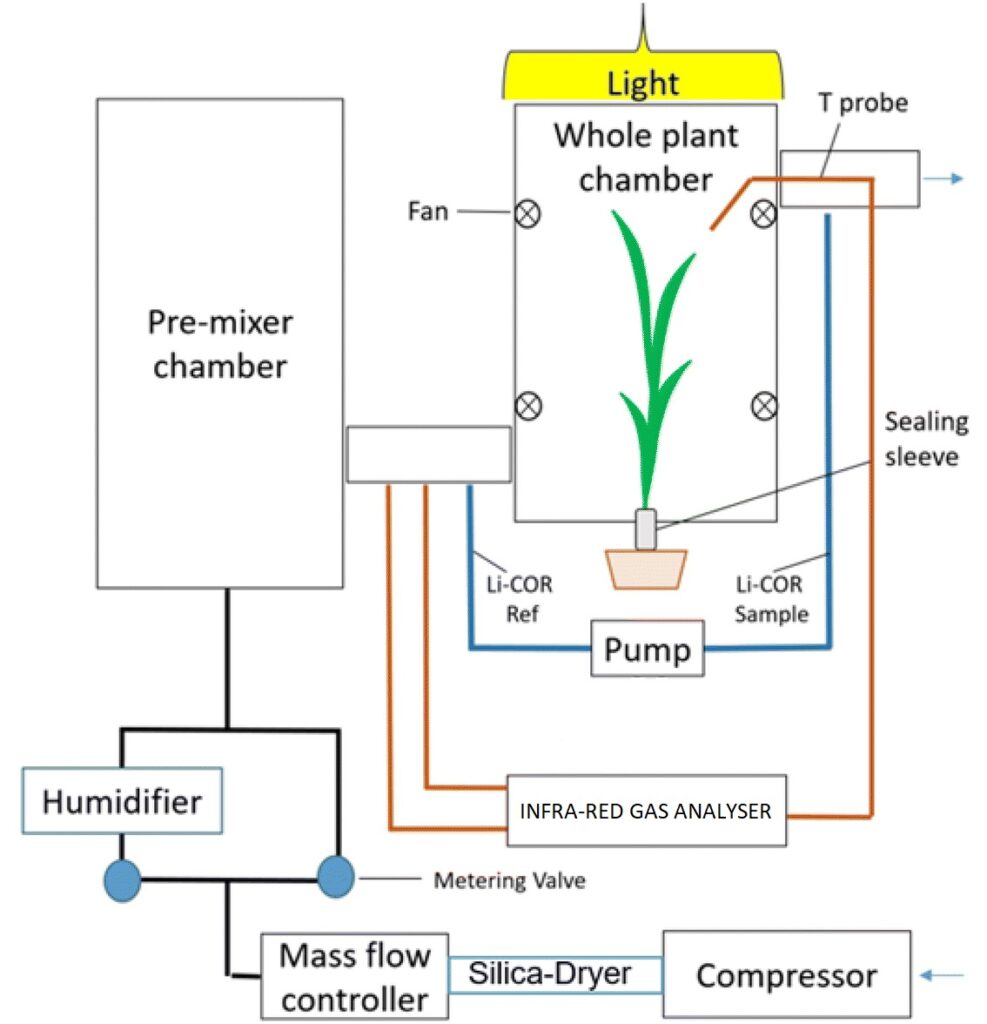
- Gas exchange measurements at the leaf level are carried out using portable infrared gas analysers (LiCor 6400, PPSystems Ciras 2). Physiological (net photosynthesis, leaf transpiration, stomatal conductance and substomatal CO2 concentration) and environmental parameters (photosynthetically active radiation, air temperature, leaf temperature, relative humidity and vapour pressure difference) are simultaneously measured. Measurements are also made of the response of photosynthesis to changes in light intensity and CO2 concentration for quantifying parameters such as the quantum yield of photosynthesis, the efficiency of carboxylation, and the compensation and saturation point of photosynthesis at a light intensity, as well as the CO2 compensation point.
- Simultaneously with the gas exchange measurements, both non-modulated and modulated leaf fluorescences are carried out for measuring internal physiological parameters relating to the light phase of photosynthesis (e.g. electron transport, ETR).
- Measurements of sap-flow are carried out at the single tree level in order to quantitatively assess the capacity of water use in the context of secondary succession of reforestation. These elements are helpful in planning ecological restoration interventions following fires, forest die-back, cutting, fungal diseases, etc.
- Several deterministic and process-based models have been developed to respond to several necessities as a) assessment of net primary productivity of a Mediterranean forest by simulation of physiological processes responding to an increase of air temperature and reduction of rainfall as highlighted in different climate change scenarios; b) hydro-geological models taking into account soil properties and environmental variables at aiming to assess the water availability either in the water table level or superficial level (root level) for determining potential plant production in limiting environments (the Mediterranean, savannah, semi-arid and arid lands), also considering the grazing pressure in time.

Land Use and Land Use Change assessment for implementing Spatial Decision Support Systems in order to manage and mitigate the effects caused by desertification in semi-arid Mediterranean/Arabian/African areas
- Different scale factors have been used in the modelling practices to up-scale or down-scale several functional variables by using the allometric theory of West, Brown and Enquist, leaf area index (LAI) as calculated in function of plant productivity, some remotely sensed products as NDVI and EVI or phenology products coming from MODIS or Sentinel 1 and 2 satellite data and implemented in deterministic models as time-based functions. The acquisition of modelling techniques (quick basic, visual basic and object-oriented programs such as Stella 9 and Simile), following the implementation of a deterministic model based on the big-leaf approach for calculating net primary production and canopy transpiration, allowed the spatial representation of these physiological variables by using the spatial Analyst module of ArcGIS software. This approach opened potential applications when deterministic models (temporal trends but not spatial representations) were relieved with Cellular Automata (CA) models and the more useful Geographical Automata System (GAS). The GAS has been applied to the distribution of Italian plant species under different climate change scenarios and considering also the interspecific competition.

Atmospheric pollutants (nitrogen oxides, ozone, Volatile Organic compounds) and their effects on structural, and physiological characteristics of plants and their distribution
Primary research interests lie in the combined effects of tropospheric ozone and environmental stress factors on the European forests and agricultural systems. Physiological processes and symptom expression of ozone visible injury are investigated, in order to assess the risk of tropospheric ozone on natural and agricultural systems. Modelling of physiological processes affected by ozone is carried out taking into consideration both concentration-based and flux-based ozone metrics (i.e. AOT40 and PODy, respectively).
Following the first approaches to modelling, the particular interest of the Group lies in finding new non-linear methodological approaches based on a mathematics-statistical basis for the assessment of functional rules of physiological processes such as the stomatal conductance behaviour as referred to as a key parameter for controlling atmosphere-plant interactions. Efforts have been done for applying several non-linear techniques, such as Path analysis, Neural Net Analysis, and non-linear regression models, to different physiological variables of plants responding to the variation of the independent climatic variables and air pollutants. Lately, the Random Forest analysis has been used for the choice of the most important variables to be included in the linear-non linear regression models in order to predict the behaviour of the dependent variables in different environmental conditions.
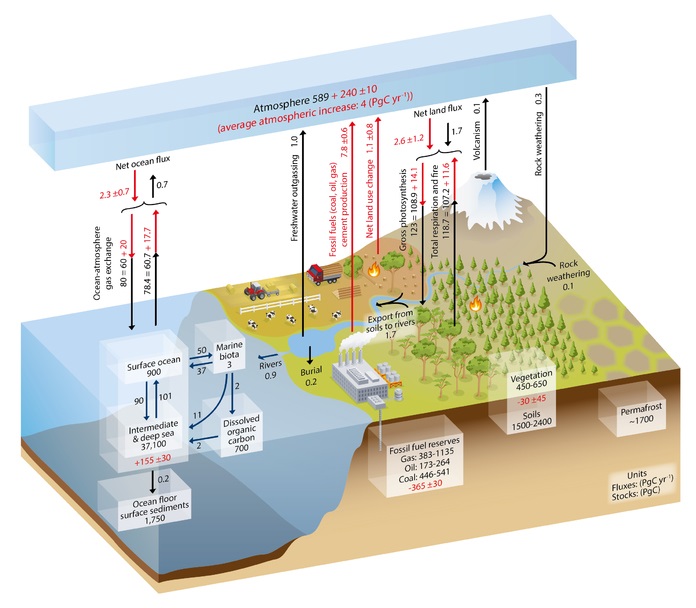
Carbon cycle assessment for forest plant communities under different climate scenarios at aiming to discriminate assimilation and respiration rates (litter decomposition and soil respiration rates)
The environmental modelling laboratory is carrying out a series of studies concerning the influence of climate change on the different interacting compartments of the carbon and water cycles at the forest stand level. In particular, the scientific interests are focused on the qualitative and quantitative definition of the litter decomposition and soil respiration processes and on their modelling, in order to include these models within the forest community models for the C cycle assessment.